What is a false 9?
A false 9, or false nine, is a centre-forward who starts up front but drops deep into the space between the opposition's midfield and defence. That forces a centre-back to choose: follow and leave a gap, or stay and let the 9 turn with the ball.
In this film
False 9 vs a normal striker
A normal number 9 lives between the centre-backs. That makes the job simple for the defence: the striker is marked, pinned and easy to find.
A false 9 starts in the same place but doesn't play like a striker. Instead of staying high, the false 9 drops into the space between midfield and defence, where nobody's job is clear.
What kind of player plays false 9?
Usually a playmaker rather than a target man. The role needs someone who can receive the ball, turn and pass in tight spaces, because that's where the false 9 spends the match.
The centre-back's choice
This is why the role causes so much trouble. When the 9 drops, a centre-back has two options, and both have a cost.
If the centre-back follows
The back four becomes a back three, and there's a gap exactly where the centre-back used to be. One touch from the 9 can open it: the 9 lays the ball off, a midfielder plays it through and a winger cuts inside into the hole. The centre-back is stranded in midfield facing the wrong way, too late to recover without a foul.
If the centre-back stays
Now the 9 is free to turn and run at the defence. It gets worse, because by dropping, the 9 becomes an extra midfielder. Three against three in the middle becomes four against three, and whoever owns the middle owns the ball.
Who made the false 9 famous?
Pep Guardiola turned Lionel Messi into the most famous false 9 ever at Barcelona from 2009. Messi wore the number 10 but played the role.
Spain then won Euro 2012 using Cesc Fàbregas, a midfielder, as their false 9 in several games, including the final.
The catch: nobody's in the box
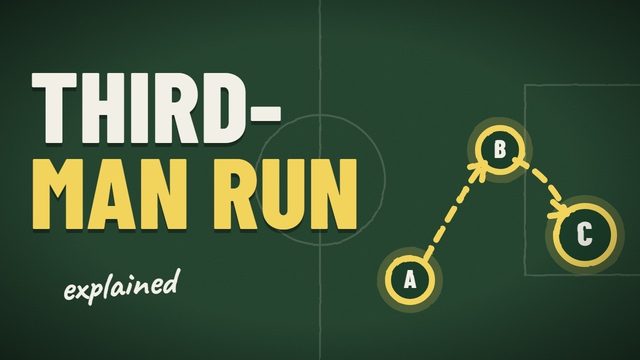
A false 9 leaves the penalty area empty. If no one runs beyond the 9, it's all passes and no goals. The role only works when wingers or midfielders arrive in the space the 9 has left. That's the same idea behind the third-man run, where the 9 drops and lays the ball off for a runner.
Common questions
Is a false 9 a striker?
Yes and no. A false 9 starts in the striker's position but plays more like a midfielder, dropping deep instead of staying between the centre-backs.
Why is it called a false 9?
Number 9 is the traditional shirt number of a centre-forward. The player appears to be one on the team sheet, but doesn't play like one. That's the 'false' part.
Is a false 9 just a 10?
No. A number 10 starts behind the striker. A false 9 starts as the furthest player forward and then drops, which is what creates the problem for the centre-backs.
Was Messi a false 9?
Yes. Messi wore the number 10 but played as Guardiola's false 9 at Barcelona from 2009.
Did Spain play with a false 9?
Yes. Spain won Euro 2012 using Fàbregas, a midfielder, as their false 9 in several games, including the final.
What is the weakness of a false 9?
Nobody's in the box. If no teammate runs beyond the false 9, a team can keep the ball without creating real chances.
We put a new football term on the board every week. Subscribe on YouTube.